
Guía de materiales de tela de nailon
Puntos Clave
- Existen cinco tipos principales que cumplen distintas funciones: Nylon 6,6 para durabilidad en exteriores, Nylon 6 para elasticidad en ropa deportiva y Nylon 12 para prendas suaves y flexibles.
- El nailon supera al algodón en resistencia a la tracción (85 MPa frente a 50 MPa), pero es inferior en transpirabilidad y biodegradabilidad.
- El nailon reciclado (ECONYL) reduce las emisiones de CO₂ hasta en un 80 % en comparación con la fibra virgen (Textile Exchange, 2023).
- Los proveedores certificados deben poseer como mínimo las certificaciones ISO 9001, ISO 14001 y OEKO-TEX Standard 100.
El nailon es uno de los tejidos sintéticos más utilizados en el planeta, y con razón. Desde que DuPont lo introdujo comercialmente en 1938 como sustituto de la seda, el nailon se ha extendido a la ropa deportiva, la maquinaria industrial, el equipamiento para actividades al aire libre y la moda.
Pero no todo el nailon es igual. El material que necesitas para una camiseta ligera para correr es diferente del que especificarías para una tienda de campaña de grado militar o una cinta transportadora. Esta guía cubre los cinco tipos principales, sus propiedades, las ventajas y desventajas ambientales y qué buscar al abastecerse a gran escala, especialmente cuando se trabaja con grandes proveedores de accesorios para prendas de vestir y telas.
¿Cuáles son los principales tipos de tejido de nailon?
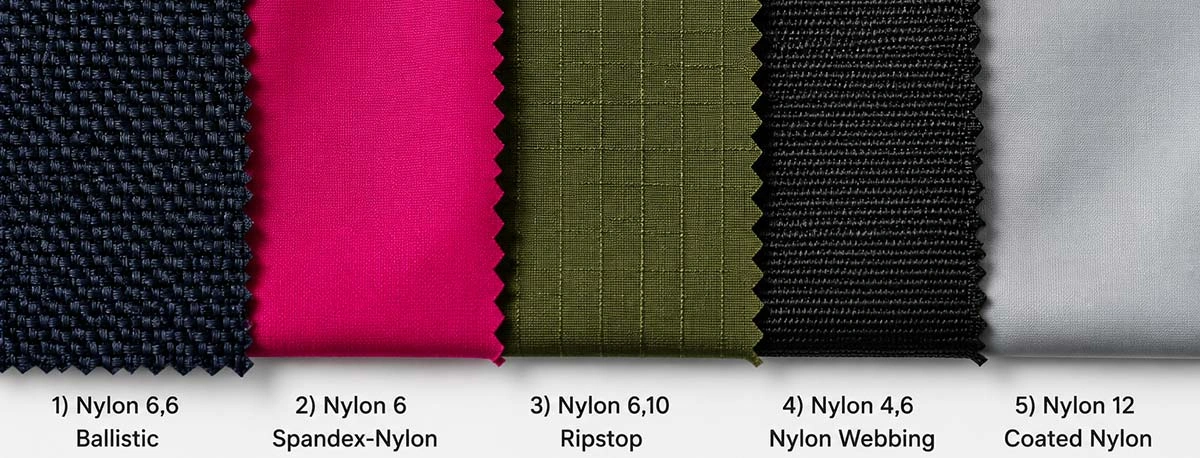
La familia del nailon incluye cinco variantes de gran importancia comercial, y los tipos que la mayoría de los compradores comparan son el nailon 6 y el nailon 66. Esta variedad explica por qué el nailon se utiliza en tantas aplicaciones textiles, desde prendas de vestir hasta tejidos técnicos. El nailon 6,6 predomina en aplicaciones militares y para actividades al aire libre, con un punto de fusión de 265 °C. El nailon 6 es el material principal en la producción de ropa deportiva gracias a su excelente capacidad de teñido. El nailon 6,10, el nailon 4,6 y el nailon 12 se utilizan en aplicaciones industriales, de alta temperatura y de uso flexible, respectivamente (clasificación ASTM D5590).
Nylon 6,6 Fabricado con dos monómeros de 6 átomos de carbono, el nailon 6,6 tiene el punto de fusión más alto (265 °C) y la mejor resistencia a la abrasión de su familia. Es el material preferido para equipos de exterior (tiendas de campaña, mochilas, cuerdas) y componentes industriales sometidos a esfuerzos mecánicos. El nailon balístico es una variante resistente y de alta resistencia utilizada en aplicaciones industriales exigentes. Su desventaja radica en que es más difícil de teñir de forma uniforme que el nailon 6 y suele costar entre un 10 % y un 15 % más por kilogramo. Algunos proveedores también lo presentan como ideal para aplicaciones impermeables, como los tejidos para trajes de baño.
Nylon 6 Fabricado a partir de un único monómero (caprolactama), el Nylon 6 se funde a una temperatura ligeramente inferior de 220 °C, pero se tiñe de manera más uniforme y tiene mejor elasticidad. La mayoría de las prendas deportivas de alto rendimiento —mallas, trajes de baño, ropa de ciclismo— utilizan Nylon 6. Absorbe el tinte lo suficientemente bien como para obtener colores vibrantes y resistentes a la decoloración.
Nylon 6,10 Esta variante cambia un monómero por una cadena de carbono más larga, lo que la hace más resistente a la absorción de humedad y a los productos químicos. Es común en mangueras industriales, fundas de cables, Hilo de pescar y cordel de pescay algunas aplicaciones para la industria automotriz en lugar de para la confección de ropa.
Nylon 4,6 Diseñado para entornos de calor extremo, el Nylon 4,6 conserva sus propiedades mecánicas incluso con una exposición continua a 120 °C. Sus principales mercados son las piezas de automóviles, los conectores eléctricos y los componentes de ingeniería de precisión.
Nylon 12 Es el más flexible y resistente a los impactos del grupo. La menor absorción de agua del Nylon 12 (0.25 % frente al 3.5 % del Nylon 6,6) lo hace ideal para productos textiles, tubos flexibles, aislamiento eléctrico y componentes de dispositivos médicos.
¿Cómo se compara el nailon con el algodón y el poliéster?
La elección de telas rara vez se trata de que un material sea "mejor", sino de qué concesiones se pueden aceptar. Aquí presentamos una comparación directa de los factores más importantes para los fabricantes de ropa.
El nailon supera al algodón en resistencia a la tracción en aproximadamente un 70 % (85 MPa frente a 50 MPa) y se seca rápidamente porque no absorbe líquidos con facilidad. En comparación con el poliéster, el nailon tiene una resistencia a la abrasión superior, pero cuesta entre un 20 % y un 30 % más por metro. El algodón sigue siendo la única opción transpirable y totalmente biodegradable en condiciones de compostaje estándar (Textile Exchange, 2023).
Nailon vs algodón
|
Factor |
Nailon |
Algodón |
|---|---|---|
|
Resistencia a la tracción |
85 MPa |
30–50 MPa |
|
Tiempo de secado |
30 – 60 min |
2-3 horas |
|
transpirabilidad |
Bajo |
Alto |
|
Biodegradabilidad |
No |
Sí (3–6 meses) |
|
Resistencia a los rayos UV |
Moderado |
Moderado |
|
Cuidados |
Lavar a máquina en frío |
Lavado a máquina con agua tibia |
El algodón es la mejor opción para la comodidad diaria, la ropa de clima cálido y cualquier prenda que se comercialice como ecológica. El nailon, por su parte, es ideal para ropa deportiva de alto rendimiento, equipamiento y artículos que necesitan soportar un uso intensivo, gracias a su ligereza. Además, es fácil de cuidar, no encoge y resiste las arrugas manteniendo su forma.
Nylon vs Poliéster
|
Factor |
Nailon |
Poliéster |
|---|---|---|
|
Resistencia a la abrasión |
Excelente |
Bueno |
|
Resistencia a los rayos UV |
Moderado |
Excelente |
|
Absorbe la humedad |
Mejor |
Bueno |
|
Precio (promedio) |
$3–8/metro |
$1–3/metro |
|
Resistencia al pilling |
Mejor |
Moderado |
|
Teñibilidad |
Excelente |
Bueno |
El poliéster es la opción económica para productos de exterior expuestos a los rayos UV, incluidos los ligeros. tejidos de poliéster pongee Para cubiertas y forros. El nailon justifica su precio superior en todo aquello que deba soportar un uso intensivo: equipaje, correas militares, empeines de calzado, equipo de escalada. Además, proporciona una sensación de comodidad durante actividades de alta intensidad.
¿Es buena la tela de nailon para la ropa?
Sí, con una salvedad importante. El nailon es excelente para prendas técnicas, pero no es una buena opción para el uso diario informal en climas cálidos. Su baja transpirabilidad (normalmente inferior a 30 cm³/cm²/s, frente a más de 150 del algodón) retiene el calor. Esto no supone ningún problema para una capa base de esquí o unas mallas de compresión; resulta incómodo para una camisa de verano.
Según un informe de Textile Exchange de 2024, el nailon representa aproximadamente el 12% de la producción mundial de fibras. Esto lo sitúa como la tercera fibra sintética más común, después del poliéster y el polipropileno. Sus principales aplicaciones en la confección son la ropa deportiva, los trajes de baño, las medias, la ropa de abrigo y el nailon mezclado con elastano para prendas ajustadas, categorías en las que la elasticidad, la durabilidad y la gestión de la humedad superan las preocupaciones sobre la transpirabilidad, de forma similar a como tejidos elásticos de poliéster y elastano servir prendas de alta movilidad.
Los mejores usos del nailon en la confección de ropa: Equipaciones deportivas escolares y enfoque en el rendimiento telas de uniformes escolares También pueden beneficiarse de la durabilidad y la capacidad de gestión de la humedad del nailon cuando se mezclan adecuadamente.
-
Ropa deportiva y mallas atléticas, especialmente prendas elásticas de alto rendimiento.
-
Trajes de baño (resistentes al cloro, de secado rápido)
-
Medias y pantimedias, incluido el uso prolongado de nailon en las medias (nailon 6 de baja densidad).
-
Cortavientos y chaquetas impermeables (Nylon 6,6 revestido)
-
Lencería y fajas (suavidad + elasticidad); sus propiedades de absorción de la humedad también benefician a la ropa deportiva, lo que convierte al nailon en una excelente opción para prendas que necesitan secarse rápidamente.
**Dónde evitar el nailon:** Camisas de verano sin forro, ropa de trabajo gruesa y cualquier prenda que se use en condiciones húmedas sin tratamiento antihumedad. Para estas aplicaciones, las mezclas de algodón y nailon (normalmente 60/40) ofrecen resistencia sin retener el calor, aunque el nailon también resiste mejor el moho, los hongos y los insectos que muchas fibras naturales en prendas que se usan en ambientes húmedos.
¿La tela de nailon es impermeable?
El nailon es resistente al agua por naturaleza, no impermeable; hay una diferencia práctica. Una capa exterior de nailon 6,6 sin tratar repelerá la lluvia ligera durante 10-15 minutos. Un aguacero prolongado, la presión o la abrasión harán que el agua penetre, por lo que a menudo se combina con una capa impermeable ligera. tejidos de poliéster para prendas exteriores en sistemas multicapa.
Los fabricantes logran una verdadera impermeabilización a través de dos vías principales:
Recubrimiento DWR (repelente al agua duradero) — Un acabado libre de fluorocarbonos o PFC aplicado a la superficie de la fibra que hace que el agua forme gotas y se deslice. Las clasificaciones comienzan alrededor de 1,500 mm de columna de agua (suficiente para lluvia ligera) y alcanzan los 5,000-10 000 mm para uso intensivo en exteriores.
Laminado de PU (poliuretano) — Una membrana adherida que bloquea físicamente la penetración del agua. El nailon laminado con poliuretano suele alcanzar valores de columna de agua de 10 000 a 30 000 mm y es estándar en ropa de lluvia de alto rendimiento y tiendas de campaña técnicas.
La clasificación de columna de agua mide la presión que un tejido puede soportar antes de que se produzcan fugas. La norma ISO 811 define las clasificaciones en milímetros: 1,500 mm para lluvia ligera, 5,000 mm para lluvia moderada y actividad física, y más de 10 000 mm para lluvia intensa o actividades de alta exigencia, como el montañismo. La mayoría de las marcas de ropa para actividades al aire libre especifican el tipo de laminado junto con la clasificación de transparencia.
¿Dónde conseguir tela de nailon?
Encontrar un proveedor confiable de tela de nailon a gran escala se reduce a tres criterios: calidad constante en pedidos grandes, certificaciones transparentes y comunicación receptiva cuando las especificaciones necesitan cambiar, especialmente dada la versatilidad del nailon en prendas de vestir, productos técnicos y artículos de viaje; proveedores que también proporcionen hilos de coser de poliéster para la producción de prendas de vestir puede simplificar su proceso de abastecimiento.
Busque proveedores que puedan proporcionar:
-
Informes de pruebas (resistencia a la tracción, solidez del color, presión hidrostática) para cada lote de producción.
-
Documentos de certificación vigentes (no certificados ISO/OEKO-TEX caducados)
-
Cantidades mínimas de pedido que se ajusten a su volumen de producción o que le permitan realizar muestras por metro.
-
Plazos de entrega claros tanto para tejidos estándar como para tejidos personalizados.
MH Industry (Ningbo) suministra tela de nailon a fabricantes de prendas de vestir y mayoristas de telas a nivel mundial, con existencias nylon resistente al agua, tela de nailon ripstop Variantes y compuestos tejidos a medida con documentación ISO 9001, ISO 14001, OEKO-TEX y REACH disponible bajo petición. Sus aplicaciones finales abarcan desde prendas de abrigo y bolsos hasta bolsas de lona, tapicería, cuerdas, arneses de seguridad, pancartas publicitarias y banderas para exteriores.
El nailon también se puede combinar con otras fibras en productos tejidos a medida para crear un rendimiento específico para cada aplicación, al igual que Mezclas de tejidos de sarga TC 65/35 Combinamos durabilidad y comodidad en ropa de trabajo y uniformes. Contacta con nuestro equipo para consultar especificaciones, muestras o precios.


Preguntas frecuentes sobre el material de tela de nailon
¿Es transpirable el tejido de nailon?
El nailon tiene una transpirabilidad baja en comparación con las fibras naturales. La permeabilidad al aire del nailon tejido estándar oscila entre 10 y 30 cm³/cm²/s, frente a los 100-200 cm³/cm²/s del algodón tejido comparable. Los fabricantes mejoran la transpirabilidad mediante estiramiento mecánico, perforación o mezcla de nailon con fibras naturales; en mezclas centradas en la comodidad, el nailon puede combinarse con otras fibras como alternativas, y una mezcla de nailon y algodón al 70/30 suele alcanzar entre 60 y 80 cm³/cm²/s, un rendimiento comparable al de tejidos duraderos. sarga de poliéster y algodón tejidos para ropa de trabajo.
¿Se puede reciclar la tela de nailon?
Sí. El nailon es un material sintético fabricado a partir de petróleo, un recurso no sostenible derivado del petróleo. Tanto el nailon posconsumo (prendas de vestir, medias) como el preconsumo (fabricación de adornos, redes de pesca) se pueden despolimerizar químicamente hasta convertirlos de nuevo en monómero de caprolactama y volver a hilar para obtener fibra de calidad virgen. El proceso ECONYL® de Aquafil es el sistema comercial más utilizado. Desde el punto de vista medioambiental, el nailon no es biodegradable, puede persistir durante cientos de años, su producción utiliza grandes cantidades de agua que pueden causar contaminación y libera óxido nitroso, aproximadamente 300 veces peor que el CO2. Los materiales sintéticos no tejidos como tejidos no tejidos de polipropileno Se plantean interrogantes similares en torno a la gestión al final de la vida útil de los productos. No todas las plantas de reciclaje aceptan textiles de nailon para el reciclaje mecánico, por lo que los programas de reciclaje químico son actualmente la principal vía para su gestión al final de su vida útil.
¿Cuál es la diferencia entre el nailon ripstop y el nailon estándar?
El nailon Ripstop tiene un patrón de rejilla reforzado tejido a intervalos regulares —normalmente cada 5-8 mm— utilizando hilos entrelazados más gruesos. En el proceso de fabricación, los gránulos de polímero de nailon se funden, se fuerzan a través de hileras, luego se estiran y se hilan en hilos antes de que las fibras de nailon resultantes se tejan para formar la tela. Cuando comienza un desgarro, la rejilla impide que se propague. Los desgarros del nailon estándar pueden recorrer toda la longitud de una costura. El Ripstop es estándar para paracaídas, tiendas de campaña, cometas y cualquier aplicación donde un pequeño desgarro que se convierta en catastrófico sea un riesgo real, mientras que los tejidos de punto estructurados como Tejidos de cuello de punto acanalado de poliéster Son más comunes en polos y camisetas informales.
¿Es seguro el tejido de nailon para el contacto con la piel?
El nailon en sí es químicamente inerte y, por lo general, seguro para el contacto con la piel. Las preocupaciones surgen de los productos químicos de acabado —tintes, repelentes de agua, tratamientos antimicrobianos— que se aplican durante el procesamiento, y el nailon también se puede teñir en muchos colores durante el acabado. La certificación OEKO-TEX Standard 100 es el indicador más fiable de que un tejido de nailon acabado ha sido sometido a pruebas para detectar residuos nocivos en niveles seguros para el contacto directo con la piel.
